

Homework shouldn’t take three hours every night. Learn why some children work twice as hard as their classmates—and how visual problems can make even simple assignments feel exhausting.
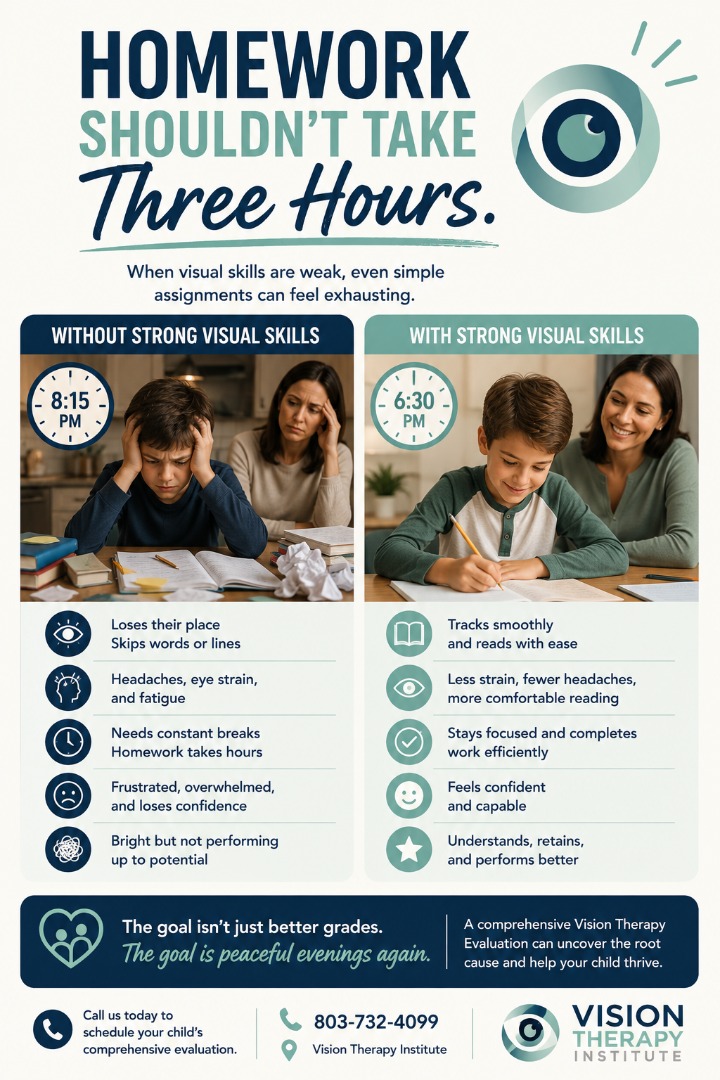
Your child sits down to do homework.
Twenty minutes later, they’re still on the first page.
They’ve gotten up three times.
They’re rubbing their eyes.
They’re frustrated.
You’re frustrated.
Eventually someone says,
“Just focus.”
Or…
“You’re not even trying.”
But what if they are?
What if your child is working incredibly hard just to keep the words clear?
Homework should challenge a child’s mind—not overwhelm their visual system.
When Homework Becomes a Daily Battle
Every family has difficult homework nights occasionally.
But if homework is consistently taking two or three hours when it should take thirty minutes, it’s worth asking why.
Parents often assume the problem is:
- Lack of motivation
- Poor attention
- Procrastination
- Laziness
- Too many distractions
While those factors can certainly play a role, another possibility is often overlooked.
Your child’s eyes may be working much harder than they should.
Reading Is One of the Hardest Things the Eyes Do
Reading isn’t simply seeing words.
It requires dozens of visual skills working together every second.
Your child’s eyes must:
- Stay focused on the page
- Work together as a team
- Move smoothly from word to word
- Keep their place across each line
- Change focus between the paper, computer, and classroom board
- Process and remember visual information
When one or more of these skills isn’t working efficiently, every assignment requires extra effort.
The result?
Homework becomes mentally and physically exhausting.
Signs Homework Is Becoming Visually Fatiguing
Does your child:
- Need constant breaks?
- Read the same sentence multiple times?
- Rub their eyes?
- Lose their place?
- Complain that words blur or move?
- Become emotional during homework?
- Work much slower than classmates?
- Seem completely drained afterward?
These may be signs that your child’s visual system is becoming fatigued—not that they’re unwilling to learn.
“They Can Play Video Games for Hours…”
Parents often ask,
“If their eyes are the problem, why can they play video games all afternoon?”
It’s a great question.
Video games and reading place very different demands on the visual system.
Reading requires precise eye movements, sustained focus, accurate tracking, and continuous processing of small, detailed print.
Video games provide:
- Larger moving targets
- Constant visual feedback
- Frequent movement
- High engagement
- Less demand for sustained line-by-line tracking
A child who struggles with reading may still enjoy visually stimulating activities.
That doesn’t mean reading is comfortable.
Visual Fatigue Can Look Like Poor Attention
As the eyes become tired, children often begin to:
Avoid work
Fidget
Lose concentration
Rush
Guess
Skip questions
Ask to use the bathroom
Need frequent snacks or breaks
These behaviors are often interpreted as attention problems.
Sometimes they are.
But sometimes they’re the natural response to a visual system that’s working overtime.
Your Child May Be Working Harder Than Everyone Else
Imagine running a race while carrying a heavy backpack.
You might finish.
But you’ll use far more energy than everyone around you.
That’s what many children with visual problems experience every day.
They often compensate for years.
They memorize instead of reading.
They guess unfamiliar words.
They skip difficult passages.
They avoid books altogether.
Eventually, they become convinced they simply “aren’t good at school.”
How a Comprehensive Vision Therapy Evaluation Helps
A comprehensive Vision Therapy Evaluation looks beyond whether your child can see clearly.
It evaluates how efficiently the entire visual system works during reading and learning.
Depending on your child’s symptoms, the evaluation may assess:
- Eye tracking
- Eye teaming
- Focusing ability
- Convergence
- Visual endurance
- Visual processing
- Visual memory
- Reading efficiency
- Visual-motor integration
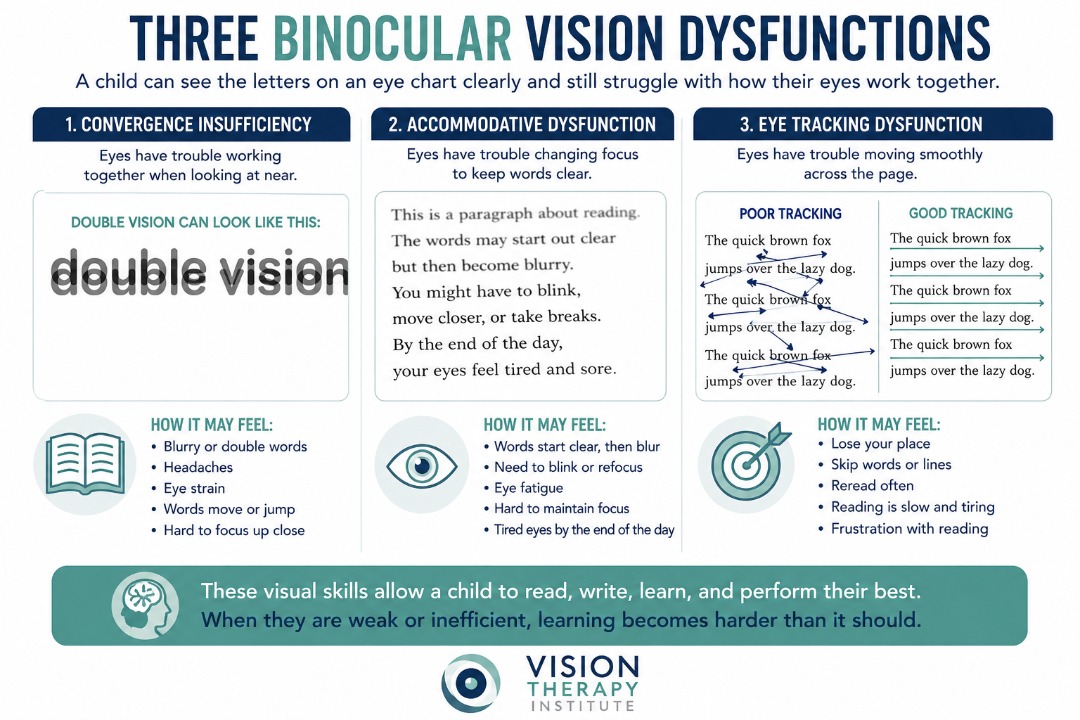
The goal is to determine whether a visual problem is making school more difficult than it needs to be.
If a visual deficiency is identified, an individualized treatment plan may be recommended.
What Is Optometric Vision Therapy?
Optometric vision therapy is a doctor-supervised treatment program designed to improve visual skills that are essential for comfortable reading and learning.
Treatment may include specialized in-office activities, therapeutic equipment, and individualized home exercises.
Vision therapy is not tutoring.
It doesn’t teach spelling, math, or reading comprehension.
Instead, it strengthens the visual abilities that support those academic skills.
For the right patient, reading may become more comfortable, homework less frustrating, and learning more efficient.
Homework Shouldn’t End in Tears
Every child gets tired sometimes.
Every child has difficult assignments.
But homework should not feel like a nightly battle.
If your child consistently spends hours on assignments, avoids reading, or becomes frustrated with schoolwork despite being bright and capable, it may be time to look beyond eyesight alone.
Sometimes the missing piece isn’t motivation.
It’s visual function.
Frequently Asked Questions
How long should homework take?
This varies by age and grade level, but if your child consistently spends significantly more time than classmates or becomes unusually exhausted by homework, it may be worth exploring why.
Can vision problems make homework take longer?
Yes. Difficulties with eye tracking, focusing, eye teaming, or visual endurance can make reading and writing much more effortful, slowing academic tasks.
Does vision therapy help every child who struggles with homework?
No. Homework difficulties can have many causes. A comprehensive Vision Therapy Evaluation helps determine whether a visual problem is contributing to your child’s challenges.
My child only struggles after about 20 minutes. Is that significant?
It can be. Some children compensate well initially but develop visual fatigue as their eyes work harder over time. Symptoms that worsen during prolonged near work are worth discussing with your eye care provider.
Is homework frustration always a vision problem?
No. Learning disabilities, ADHD, executive functioning challenges, emotional stress, and other factors can also affect homework. Vision is one important piece of the puzzle—not the only one.
What happens during a Vision Therapy Evaluation?
The evaluation measures how efficiently your child’s visual system functions during reading and learning, including eye tracking, focusing, eye teaming, convergence, visual processing, and related visual skills.
Could Vision Be Making Homework Harder Than It Needs to Be?
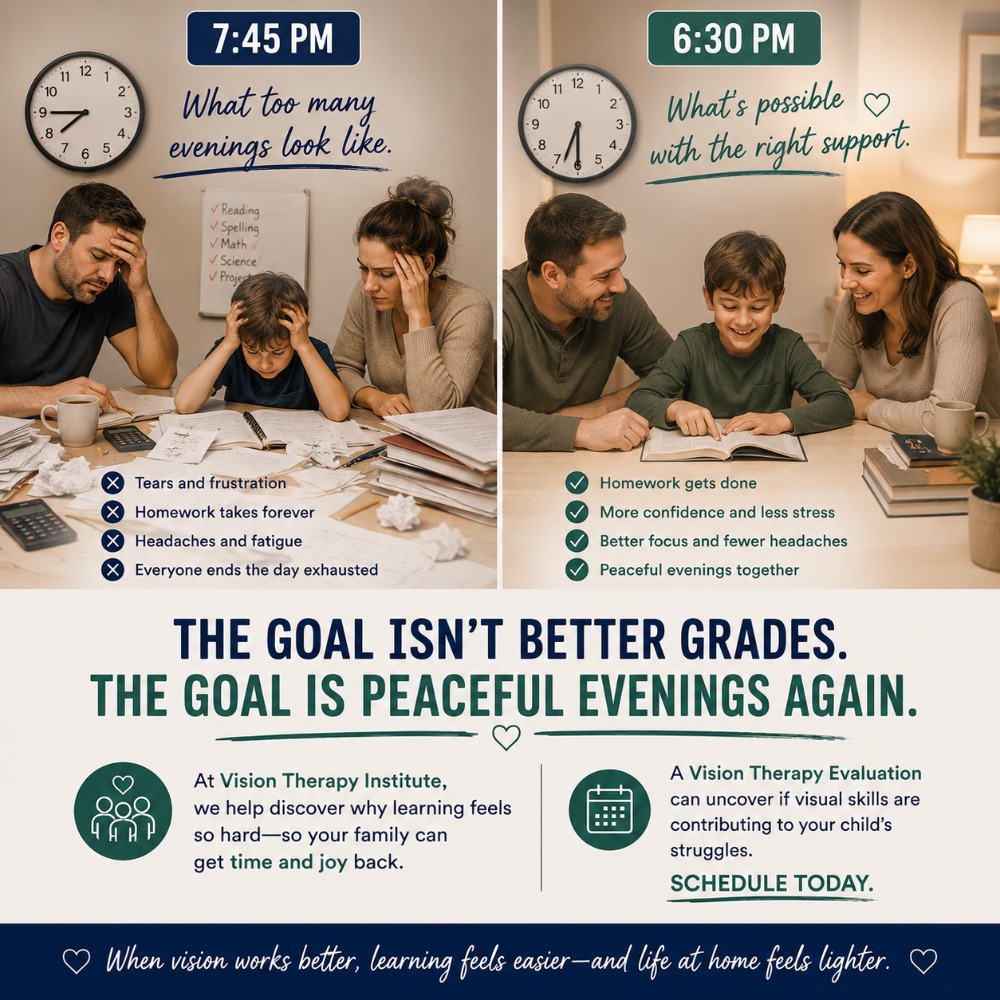
Your child shouldn’t have to spend every evening fighting through homework.
If homework consistently takes hours, causes frustration, or leaves your child mentally exhausted, a comprehensive Vision Therapy Evaluation may help identify whether visual function is part of the problem.
Call us today to schedule your child’s comprehensive evaluation.
📞 803-732-4099
📍 Vision Therapy Institute