
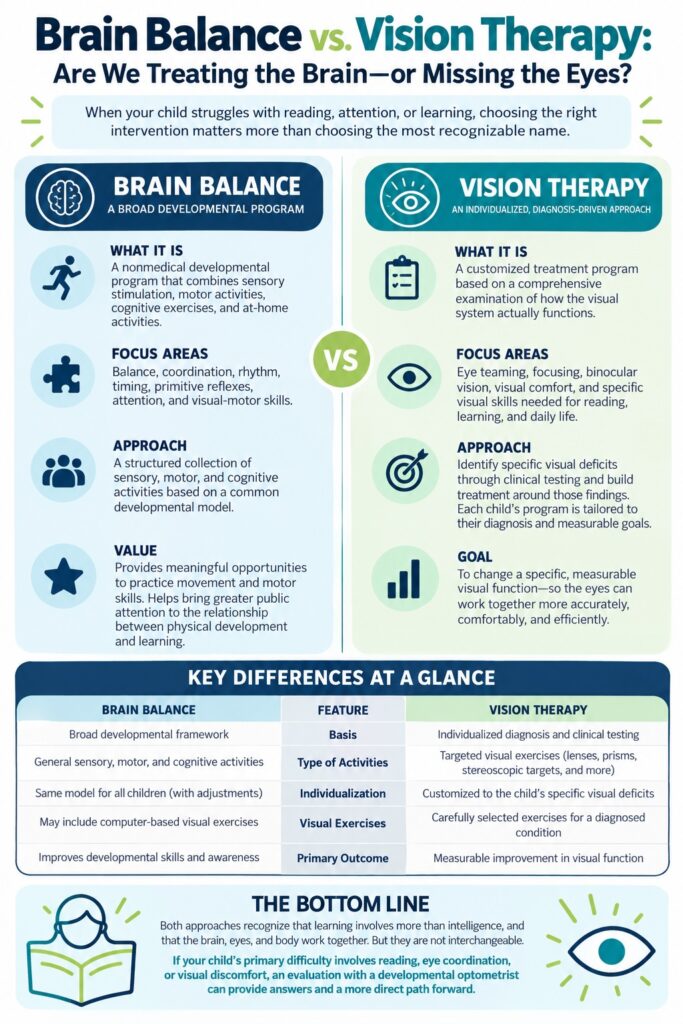
When your child struggles with reading, attention, or learning, choosing the right intervention matters.
If your child is struggling in school, you’ve probably heard of Brain Balance.
With its national marketing presence and emphasis on brain development, Brain Balance has become a familiar option for families searching for answers to attention, behavior, and learning challenges.
But there’s another intervention that parents often haven’t heard nearly as much about: developmental optometry and optometric vision therapy.
Both approaches recognize something important: learning involves much more than intelligence, and the brain, eyes, and body work together in remarkably complex ways.
But they are not interchangeable.
And when a child’s primary difficulty involves reading, eye coordination, or visual discomfort, understanding the difference can save families valuable time, money, and frustration.
First, What Does Brain Balance Actually Do?
Brain Balance is a nonmedical developmental program that combines sensory stimulation, motor activities, cognitive exercises, and at-home activities.
Children may work on balance, coordination, rhythm, timing, primitive reflexes, attention, and visual-motor skills.
I see value in some of these experiences.
For a child who needs additional opportunities to develop coordinated movement, spending several days a week engaged in structured, progressive motor activities may provide meaningful opportunities to practice skills.
Movement matters. Sensory integration matters. Motor development matters.
And I appreciate that Brain Balance has helped bring greater public attention to the relationship between physical development and learning.
But here’s where I think parents need to ask a harder question: If your child is struggling to read, is a broad developmental program the most direct way to address that problem?
The Difference Between a General Developmental Program and an Individualized Vision Diagnosis
Brain Balance uses a broad developmental framework. Children participate in a structured collection of sensory, motor, and cognitive activities, with difficulty and emphasis adjusted according to their assessments and progress.
While Brain Balance describes its programming as individualized, the activities are organized around a common developmental model.
Optometric vision therapy starts somewhere different.
We begin with a comprehensive examination of how the visual system actually functions.
- Can your child’s eyes accurately converge on a book?
- Can they maintain clear focus as reading demands increase?
- Can they coordinate both eyes comfortably over time?
- Do they have a binocular vision disorder that makes sustained near work physically difficult?
These aren’t simply questions about whether your child can see 20/20.
A child can have perfect eyesight and still experience significant problems with eye teaming, focusing, or visual comfort.
And those problems deserve to be identified—not assumed.
In developmental optometry, we identify specific visual deficits through clinical testing and build treatment around those findings.
We aren’t simply asking whether a child can complete an exercise.
We’re asking whether that exercise addresses an identified dysfunction, whether the child is developing the intended visual skill, and whether we can objectively measure improvement.
Not All Visual Exercises Are Created Equal
Brain Balance incorporates visual exercises into its broader developmental program. Computer-based activities may also be used to practice visual-motor and cognitive skills.
But practicing an eye movement on a screen is not the same as diagnosing and treating a binocular vision disorder.
Computerized vision exercises have existed for decades. The important questions are what the exercise actually trains, whether it matches the child’s diagnosis, and whether improvement can be measured.
In optometric vision therapy, we may use specialized lenses, prisms, stereoscopic targets, accommodative techniques, and carefully controlled binocular activities.
A child with convergence insufficiency requires different interventions from a child with accommodative dysfunction or strabismus.
Even two children with the same diagnosis may require different starting points, levels of difficulty, and treatment progressions.
The goal isn’t simply to make the eyes do exercises. It’s to change a specific, measurable visual function.
And that distinction is important.
A generalized visual exercise might challenge eye movements or visual attention.
But if a child has a diagnosed binocular vision disorder, we need to know whether that exercise is appropriate for the condition and whether it produces the intended clinical change.
More exercises do not automatically mean better treatment.
More targeted exercises, selected for the right reason, may be far more meaningful.
What Does the Science Actually Say?
This is where the conversation becomes especially interesting.
The Convergence Insufficiency Treatment Trial (CITT), a major multicenter research initiative, demonstrated that office-based vergence/accommodative therapy can improve important clinical measures of symptomatic convergence insufficiency.
Convergence insufficiency is a condition in which the eyes have difficulty working together comfortably at near distances. Children may experience eyestrain, headaches, blurred or double vision, and discomfort during sustained reading.
These are real visual problems with measurable clinical findings.
The research demonstrated that appropriately delivered office-based treatment can improve convergence function and associated symptoms.
If a child experiences headaches, double vision, or eyestrain during reading because of convergence insufficiency, addressing that dysfunction can be valuable—even if it doesn’t directly change their standardized reading achievement.
Vision therapy can address certain diagnosed visual disorders.
Reading instruction addresses literacy development.
Some children need both.
And if your child has dyslexia, structured, evidence-based reading instruction remains essential.
We don’t promise that fixing the eyes will fix every learning problem. But we also shouldn’t overlook a treatable visual disorder simply because a child has been labeled with a learning difficulty.
What About the Research Behind Brain Balance?
Brain Balance has published and promoted research reporting improvements in areas such as attention, behavior, and cognitive performance.
Those findings deserve consideration.
However, it’s important to distinguish promising findings from the level of evidence required to establish that a program reliably treats a specific condition.
Some Brain Balance studies have methodological limitations, including nonrandomized designs or limited control groups. These make it difficult to determine how much improvement can be attributed specifically to the program rather than maturation, practice effects, other services, or nonspecific benefits of structured activity.
That doesn’t mean children cannot benefit.
It means parents should understand the difference between reported improvement and demonstrated treatment efficacy.
And the same scientific scrutiny should apply to vision therapy.
We should evaluate each intervention based on the specific condition being treated, the quality of the research, and the outcomes that matter.
Where Brain Balance May Fit
I don’t believe every child needs vision therapy.
And I certainly don’t believe every child needs Brain Balance.
A child whose greatest challenges involve motor coordination, balance, or opportunities for structured physical development may benefit from a program that emphasizes repeated motor practice.
Brain Balance may offer families a motivating, consistent environment for those activities, although evidence for its broader cognitive and academic claims should be evaluated separately.
But if your child is losing their place when reading, experiencing headaches during homework, seeing double, or struggling to sustain clear, comfortable near vision, I would want a comprehensive binocular vision evaluation before investing in a generalized brain-training program.
Why?
Because we should first determine whether a specific, treatable visual disorder is contributing to those symptoms.
A child with convergence insufficiency doesn’t necessarily need more balance exercises.
They need their convergence insufficiency evaluated and appropriately managed.
A child with accommodative dysfunction doesn’t necessarily need a generalized cognitive training program to address blurry near vision.
They need an evaluation of their focusing system and treatment appropriate to the diagnosis.
And a child with dyslexia needs evidence-based reading instruction, whether or not they also have a visual disorder.
The right intervention depends on the actual problem—not simply the symptoms that brought the family through the door.
Here’s the Question I Wish More Parents Would Ask
Instead of asking, “Which program will help my child’s brain?”
Ask:
“What specific skill is my child struggling with, how do we know, and how will we measure whether treatment is working?”
Children are complex. Their care should reflect that complexity.
Parents should feel empowered to ask any provider what their child’s diagnosis is, which outcomes the proposed intervention has been shown to improve, and how progress will be documented.
Those questions aren’t confrontational.
They’re the foundation of informed healthcare decisions.
My Perspective as a Developmental Optometrist
I love that parents are increasingly recognizing that learning involves the whole child.
But I worry when the popularity of a program becomes more influential than the specificity of the intervention.
Marketing can introduce families to possibilities. It cannot tell us what an individual child needs.
At Vision Therapy Institute, we believe in evaluating the visual system carefully, identifying measurable areas of dysfunction, and designing treatment around the individual patient.
Sometimes that means vision therapy.
Sometimes it means glasses, a referral, educational intervention, or a combination of services.
And sometimes it means reassuring parents that their child’s vision is functioning well and encouraging them to pursue answers elsewhere.
My concern is that families may spend thousands of dollars and months of their child’s developmental years pursuing a broad intervention without first identifying whether a specific, treatable visual disorder is contributing to their struggles.
And when it comes to a child’s education and development, time matters.
The best intervention isn’t necessarily the one that trains the most skills. It’s the one that addresses the right problem.
Before you invest months in any developmental program, make sure you know exactly what you’re trying to change.
Your child deserves that level of precision.
Could Your Child’s Vision Be Contributing to Their Reading Difficulties?
At Vision Therapy Institute, we evaluate much more than eyesight.
Our comprehensive developmental vision evaluations assess eye teaming, focusing, eye movements, and other aspects of visual function that can contribute to discomfort and difficulty during sustained near work.
If your child struggles with reading-related visual symptoms, headaches, double vision, or difficulty maintaining clear and comfortable vision, we can help determine whether a treatable visual disorder is part of the picture.
Dr Katie Davis
Vision Therapy Institute
3618 Sunset Boulevard, Suite A
West Columbia, SC
803-732-4099
www.visiontherapysc.org
Vision therapy is not a treatment for dyslexia or a substitute for evidence-based reading instruction. A comprehensive evaluation can help determine whether a separate visual disorder also needs attention.
Research and Further Reading
- Convergence Insufficiency Treatment Trial (CITT) Study Group. A Randomized Clinical Trial of Treatments for Symptomatic Convergence Insufficiency in Children. Archives of Ophthalmology, 2008.
- CITT-ART Investigator Group. Effect of Vergence/Accommodative Therapy on Reading in Children with Convergence Insufficiency: A Randomized Clinical Trial. Optometry and Vision Science, 2019. Read the study.
- CITT-ART Investigator Group. Treatment of Symptomatic Convergence Insufficiency in Children Enrolled in the Convergence Insufficiency Treatment Trial–Attention & Reading Trial: A Randomized Clinical Trial. Optometry and Vision Science, 2019. Read the study.
- American Academy of Pediatrics and collaborating professional organizations. Learning Disabilities, Dyslexia, and Vision. Pediatrics, 2009. This policy statement emphasizes evidence-based reading instruction and the importance of distinguishing visual disorders from primary learning disabilities.
- Brain Balance. Published research and program descriptions, available at brainbalancecenters.com. These materials provide information about the program’s developmental framework and reported outcomes; individual studies should be evaluated for design and methodological limitations.