

Your child may be bright, curious, and capable—yet reading, homework, or classroom tasks still feel unusually difficult. Learn five common signs that a visual problem may be interfering with learning and when a comprehensive Vision Therapy Evaluation may help.
Your child is intelligent.
They understand stories when someone reads aloud.
They can explain complex ideas.
But when it is time to read independently, write, copy from the board, or complete homework, everything changes.
They lose their place.
They become frustrated.
They avoid the task.
They may even say, “I can’t do this.”
For parents, this can be confusing. How can a child who is so capable struggle so much with schoolwork?
In some cases, the answer may involve how efficiently the eyes and brain work together.
Vision is more than seeing clearly. It also includes the ability to track across a page, keep words clear, coordinate both eyes, process visual information, and sustain attention during close work.
When these skills are weak or inefficient, learning can require far more effort than it should.
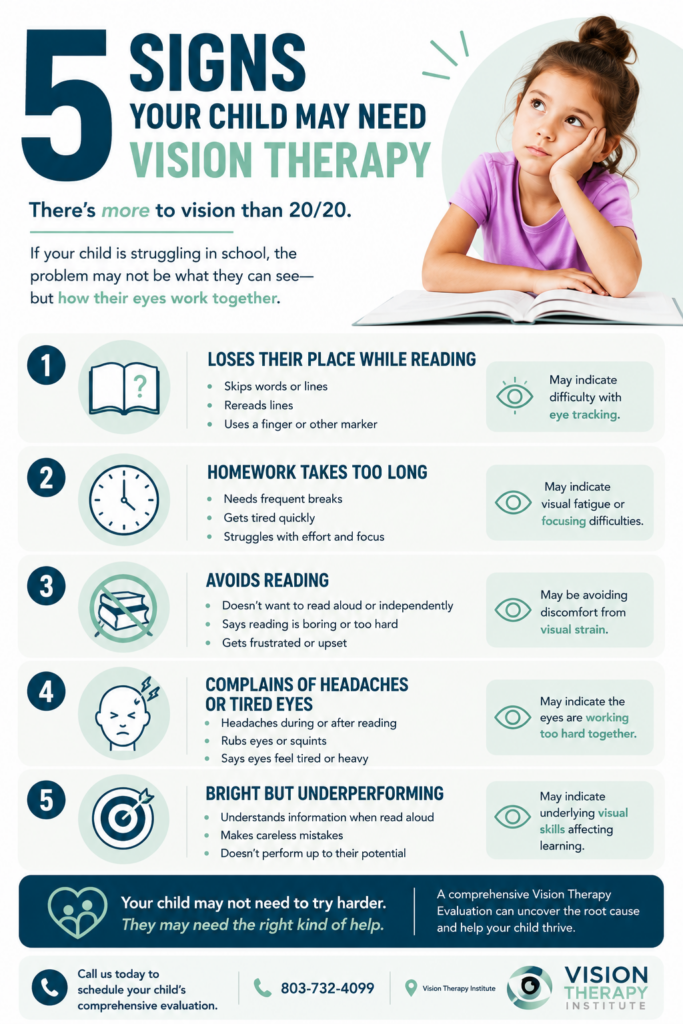
Sign 1: Your Child Loses Their Place While Reading
Does your child skip words, reread lines, or use a finger to keep their place?
These behaviors may suggest difficulty with eye tracking.
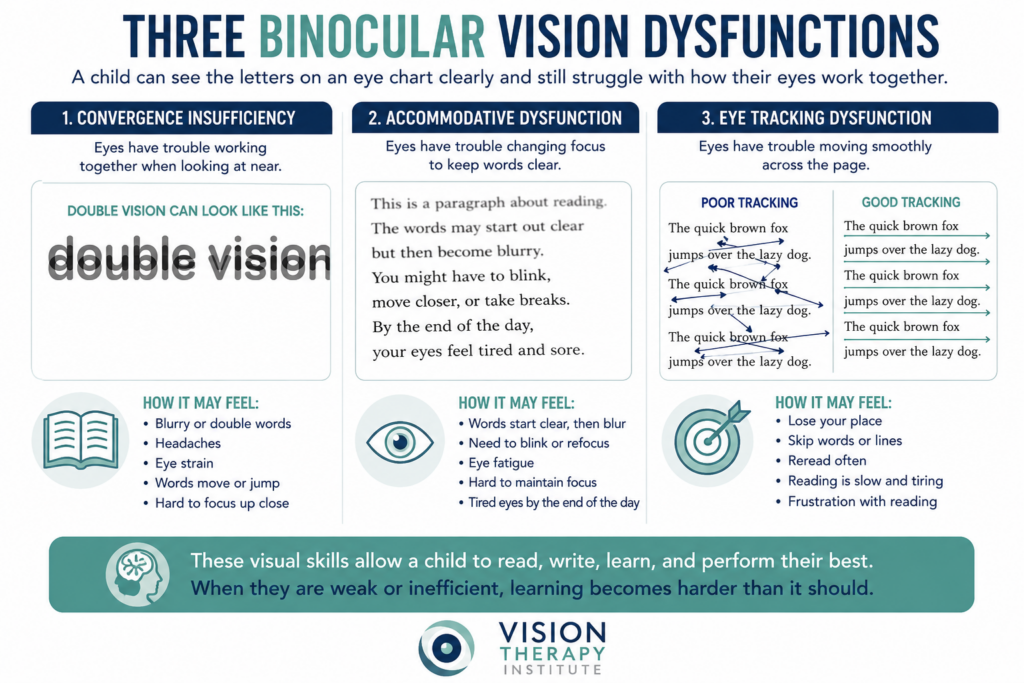
Eye tracking is the ability to move the eyes smoothly and accurately across a page. During reading, the eyes must make a series of precise movements from one word to the next while staying on the correct line.
When tracking is inefficient, a child may:
- Lose their place frequently
- Skip small words
- Repeat words or lines
- Miss entire lines of text
- Use a finger or marker to stay on track
- Turn their head instead of moving their eyes
- Read slowly or choppily
These difficulties can affect reading fluency and comprehension because so much effort is being used simply to stay on the page.
A child may understand the material but struggle to read it efficiently.
Sign 2: Homework Takes Much Longer Than It Should
Homework may take two or three times longer than expected.
A short worksheet becomes an exhausting evening.
Your child may need frequent breaks, become emotional, or seem unable to finish without constant support.
This can happen when the visual system has difficulty sustaining focus or coordinating the eyes during prolonged near work.
Reading and writing require the eyes to maintain clear, comfortable vision at close range. They must also shift focus when looking between a book, worksheet, computer, and classroom board.
If these skills are inefficient, your child may experience:
- Blurred vision after reading
- Headaches
- Eye strain
- Difficulty copying
- Slow written work
- Frequent loss of concentration
- Avoidance of homework
- Fatigue after short periods of close work
The problem may not be that your child is unwilling to work.
They may simply be using far more effort than other children to complete the same visual task.
Sign 3: Your Child Avoids Reading
Some children love stories but avoid reading independently.
They may ask a parent to read for them, choose books below their ability level, rush through assignments, or become upset when asked to read.
This avoidance may be interpreted as laziness, poor motivation, or a dislike of school.
However, children naturally avoid activities that feel uncomfortable, confusing, or exhausting.
A child may not know how to explain that:
- Words become blurry
- The page seems crowded
- Letters move or overlap
- Their eyes feel tired
- They see double
- They cannot keep their place
- Reading causes a headache
- Instead, they may simply say, “I hate reading.”
Avoidance is often a form of self-protection.
Understanding why reading feels difficult can help parents respond with support rather than frustration.
Sign 4: Your Child Complains of Headaches or Tired Eyes
Headaches during or after reading may be a sign that the visual system is working too hard.
Some children complain directly.
Others may rub their eyes, close one eye, rest their head on the desk, blink frequently, or become irritable after close work.
Visual discomfort may be related to difficulty with:
- Eye teaming
- Focusing
- Convergence
- Tracking
- Maintaining clear near vision
- Shifting focus between distances
These symptoms may worsen later in the day as the child becomes tired.
A child may perform well in the morning but struggle during homework because their visual system can no longer compensate as effectively.
Headaches can have many causes and should always be evaluated appropriately.
However, when headaches are consistently linked to reading, screens, writing, or homework, visual function should be considered.
Sign 5: Your Child Is Bright but Performing Below Their Potential
Teachers often describe these children in similar ways:
- “They are very smart.”
- “They understand the material when we discuss it.”
- “They are creative and curious.”
- “But their work does not reflect their ability.”
A child with a visual deficiency may understand concepts but struggle to access or demonstrate that knowledge efficiently.
They may:
- Read below grade level
- Work slowly
- Avoid longer assignments
- Have inconsistent performance
- Make careless mistakes
- Struggle to copy from the board
- Lose attention during reading
- Have poor reading endurance
- Perform better when information is presented verbally
This gap between ability and performance can affect confidence.
Over time, the child may begin to believe they are not smart, even though the real issue may be that their visual system is making learning unnecessarily difficult.
These Signs Do Not Always Mean Vision Therapy Is Needed
Children can struggle academically for many reasons.
Reading difficulties may involve language processing, attention, learning disabilities, emotional stress, sensory challenges, or gaps in instruction.
In many cases, more than one factor is present.
That is why a comprehensive evaluation is important.
The purpose of a Vision Therapy Evaluation is not to assume that every academic struggle is caused by vision.
It is to determine whether a visual deficiency is one piece of the puzzle.
How a Comprehensive Vision Therapy Evaluation Helps
A comprehensive Vision Therapy Evaluation looks beyond clarity of eyesight.
It examines how well the eyes and brain work together during reading, learning, movement, and other daily activities.
Depending on the child’s symptoms, the evaluation may assess:
- Eye tracking
- Eye teaming
- Focusing ability
- Convergence
- Depth perception
- Visual processing
- Visual memory
- Visual-motor integration
- Reading-related visual efficiency
- Visual endurance
The goal is to identify whether a visual problem is contributing to the child’s symptoms.
If a deficiency is found, the doctor may recommend an individualized treatment plan.
What Is Optometric Vision Therapy?
Optometric vision therapy is a doctor-supervised treatment program designed to improve specific visual skills.
Therapy may include in-office activities, specialized equipment, and home-based exercises.
The treatment plan is customized based on the child’s diagnosis, age, symptoms, and functional needs.
Vision therapy does not teach reading, spelling, or math.
Instead, it works to improve the visual abilities needed to perform those tasks more comfortably and efficiently.
For the right patient, treatment may help reduce visual strain and make reading, writing, copying, and homework feel more manageable.
Your Child May Not Need to Try Harder
Many children with visual difficulties are already trying very hard.
They may spend more time on homework, reread material repeatedly, or rely on memorization and guessing to compensate.
What looks like poor effort may actually be visual overload.
What looks like inattention may be fatigue.
What looks like avoidance may be discomfort.
Identifying the reason behind the struggle can help a child receive the right support and begin rebuilding confidence.
Frequently Asked Questions
Can a child need vision therapy even if they have 20/20 vision?
Yes. Twenty-twenty vision measures clarity at a distance. It does not evaluate eye tracking, focusing, eye teaming, convergence, visual processing, or visual endurance.
Is using a finger while reading always a problem?
No. Finger tracking can be normal in beginning readers. However, continued reliance on a finger—especially when combined with skipping lines, slow reading, headaches, or frustration—may suggest that further evaluation is appropriate.
Can vision problems look like attention problems?
Yes. A child who experiences blur, double vision, eye strain, or difficulty tracking may lose attention during visually demanding tasks. Vision problems and attention disorders can also exist at the same time.
Does vision therapy cure dyslexia?
No. Dyslexia is a language-based learning disorder. Vision therapy does not treat dyslexia. However, a child with dyslexia may also have a visual deficiency that makes reading even more difficult. A comprehensive evaluation can help determine whether both are present.
How do I know whether my child needs an evaluation?
Consider an evaluation if your child consistently loses their place, avoids reading, complains of headaches or tired eyes, struggles with homework, or performs below their apparent ability despite having clear eyesight.
What happens during a Vision Therapy Evaluation?
The evaluation measures more than eyesight. It may assess tracking, focusing, eye teaming, convergence, depth perception, visual processing, visual memory, and other skills related to reading and learning.
Could Vision Be Part of Your Child’s Struggle?
Your child may not be lazy.
They may not be unmotivated.
They may not need to simply try harder.
If your child loses their place, avoids reading, struggles through homework, complains of headaches, or performs below their potential, a comprehensive Vision Therapy Evaluation may provide important answers.
Call us today to schedule your child’s comprehensive evaluation.
📞 803-732-4099
📍 Vision Therapy Institute