

Reading difficulties aren’t always caused by blurry vision. Learn why many children with 20/20 eyesight still struggle in school—and how a comprehensive vision therapy evaluation can uncover the real cause.
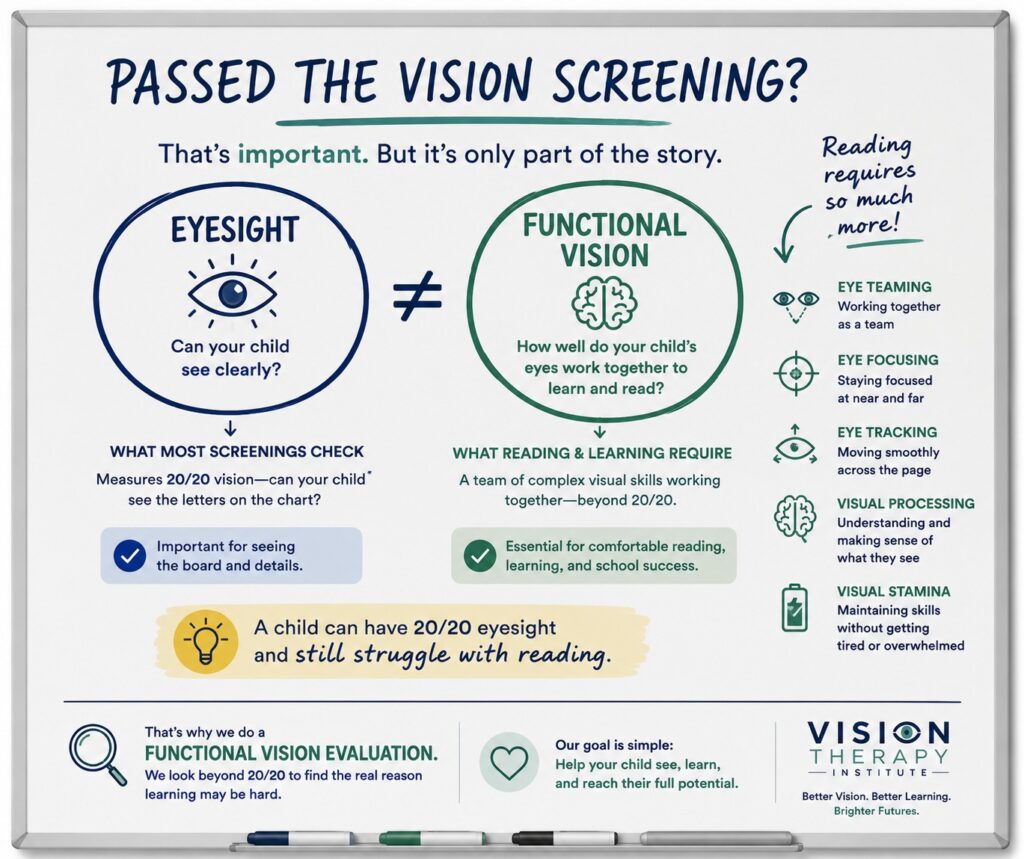
Your child passed the school vision screening. Maybe they were even told they have 20/20 vision.
But homework still takes hours.
Reading is exhausting.
They lose their place, avoid books, complain of headaches, or become frustrated before assignments are finished.
Their teacher may say, “They are so bright, but they are not performing up to their potential.”
For many parents, this is confusing. If their child can see clearly, why is school still so difficult?
The answer is that clear eyesight is only one part of vision.
What Does a School Vision Screening Test?
Most school vision screenings are designed to identify children who may have difficulty seeing clearly at a distance.
That is important, but it does not tell us how well a child’s visual system functions during reading, writing, copying, and other close-up schoolwork.
A child can see the letters on an eye chart clearly and still have difficulty with:
- Eye tracking
- Eye teaming
- Focusing
- Convergence
- Visual processing
- Visual memory
- Visual endurance
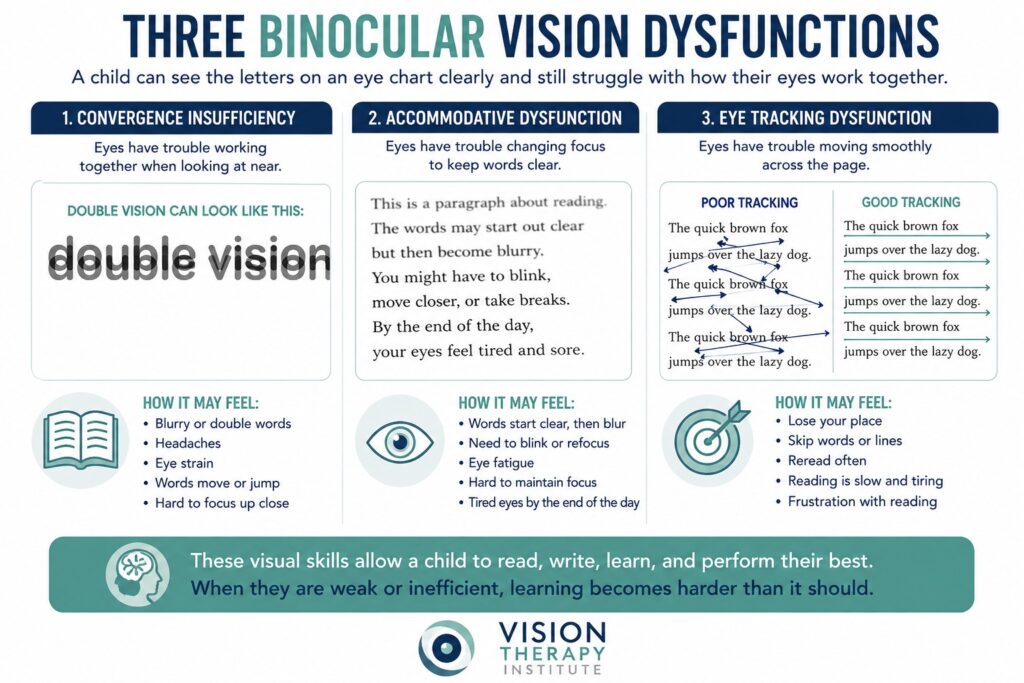
These skills allow a child to move their eyes smoothly across a page, keep words clear, use both eyes together, understand what they see, and maintain visual attention long enough to complete an assignment.
When these skills are weak or inefficient, learning can require far more effort than it should.
Why 20/20 Vision Is Not the Whole Picture
Twenty-twenty vision measures how clearly a person can see at a specific distance.
It does not measure whether the eyes can follow a line of text without skipping words. It does not tell us whether the eyes can work together comfortably or shift focus efficiently between the board and a notebook.
It also does not measure how quickly the brain processes and remembers visual information.
A child may have 20/20 eyesight and still experience significant difficulty with reading and schoolwork.
Signs That Vision May Be Affecting Learning
Children do not always know how to explain what they are experiencing. They may assume that reading feels the same for everyone.
Parents and teachers may notice signs such as:
- Losing place while reading
- Skipping words or lines
- Using a finger to keep their place
- Reading slowly
- Avoiding books or homework
- Complaining of headaches or tired eyes
- Rubbing the eyes frequently
- Closing or covering one eye
- Tilting the head while reading
- Seeing words move, blur, or double
- Struggling to copy from the board
- Having a short attention span during close work
- Becoming unusually frustrated during homework
- Performing below their apparent ability
These signs do not necessarily mean a child needs vision therapy. Academic struggles can have many causes.
However, they do suggest that a more comprehensive evaluation may be appropriate.
Your Child May Not Be Lazy or Unmotivated
When reading is visually uncomfortable, children often avoid it.
This avoidance can look like laziness, poor attention, lack of motivation, or behavioral resistance. In reality, the child may be trying to escape an activity that feels confusing, tiring, or physically uncomfortable.
Imagine trying to read while the words blur, move, overlap, or require constant effort to keep clear.
Over time, a child may begin to believe that they are a poor reader or simply “not good at school.”
Understanding the reason behind the struggle can be an important first step in rebuilding confidence.
How a Comprehensive Vision Therapy Evaluation Helps
A comprehensive Vision Therapy Evaluation looks beyond eyesight and examines how the entire visual system functions.
Depending on the child’s symptoms and needs, the evaluation may assess:
- Eye tracking
- Eye teaming
- Focusing ability
- Depth perception
- Convergence
- Visual-motor integration
- Visual processing
- Visual memory
- Reading-related visual efficiency
The goal is to determine whether a visual problem is contributing to the child’s academic difficulties.
If a visual deficiency is identified, an individualized treatment plan may be recommended.
What Is Optometric Vision Therapy?
Optometric vision therapy is a doctor-supervised treatment program designed to improve specific visual skills.
Therapy may include in-office activities, specialized equipment, and home-based exercises. The program is customized according to the child’s diagnosis, age, symptoms, and functional needs.
Vision therapy is not tutoring, and it does not teach reading or math.
Instead, it works to improve the visual abilities a child needs to access learning more comfortably and efficiently.
For the right patient, treatment may help make reading, writing, copying, and other visual tasks feel less demanding.
Could Vision Be One Piece of the Puzzle?
Not every child who struggles in school has a vision problem.
Learning difficulties may also involve language, attention, sensory processing, emotional factors, or specific learning disabilities. In many cases, multiple factors are present at the same time.
A comprehensive evaluation helps determine whether vision is contributing to the problem.
For some families, that missing piece explains why a bright child continues to struggle despite tutoring, extra practice, and support at school.
Frequently Asked Questions
Can my child have 20/20 vision and still need vision therapy?
Yes. Twenty-twenty vision only measures how clearly your child sees at a distance. It does not evaluate how well the eyes track, focus, work together, or process visual information during reading and learning.
Is vision therapy the same as tutoring?
No. Tutoring teaches academic content. Vision therapy addresses visual skills that may affect how efficiently a child reads, writes, copies, and completes other school-related tasks.
Does every child who struggles in school need vision therapy?
No. Academic struggles can have many causes. A comprehensive evaluation helps determine whether a visual deficiency is contributing to your child’s difficulties.
What age is best for vision therapy?
Treatment may be appropriate for preschool-aged children, school-aged children, teenagers, and adults. Recommendations depend on the diagnosis, developmental level, symptoms, and individual needs of the patient.
How long does vision therapy take?
The length of treatment varies. It depends on the diagnosis, severity of the visual problem, treatment goals, and consistency with therapy and home activities.
Does insurance cover vision therapy?
Insurance coverage varies by plan and diagnosis. Our team can review available benefits and explain expected costs before treatment begins.
Wondering Whether Vision Is Part of the Problem?
Your child may not need to work harder.
They may need help understanding why learning feels so hard.
If your child passed a school vision screening but continues to struggle with reading, homework, headaches, attention, or academic confidence, a comprehensive Vision Therapy Evaluation may provide important answers.
Call us today to schedule your child’s comprehensive evaluation.
📞 803-732-4099
📍 Vision Therapy Institute